Growth app
For people
A personal growth and leadership coaching app with Daily Check-Ins, Micro-Lessons, Interactive Scenarios and Peer Kudos — helping people become better humans.
Australian law now requires
Trusted by









Flourish360 is an Australian workplace psychosocial risk and wellbeing platform helping employers improve employee mental health, psychosocial safety, engagement and performance through evidence-based programs and measurable insights.
A personal growth and leadership coaching app with Daily Check-Ins, Micro-Lessons, Interactive Scenarios and Peer Kudos — helping people become better humans.

Identify, assess, control, monitor and review psychosocial risk, consulting your people at every stage, with aggregated insights, conversation guides and a reviewable evidence trail.
None of this is theoretical. This is what happens when organisations don't give their people a daily place to grow, reflect and reach out. Acting early is the kindest and smartest thing you can do — for your people and your business.
What these figures mean for your workplace
$58,615
is the median cost of a single psychological injury claim
That's roughly four times the median for a physical injury — and it's often the result of pressure building quietly without a safe, daily place for people to pause, reflect and reach out.
34.2 weeks
is the median time lost to a psychological injury
Eight months away from work, a team carrying the gap, and a person whose recovery started long after the warning signs did. Everyday support catches things earlier.
$1.9m
is the maximum fine for failing to manage a known hazard
Psychosocial hazards sit under the same WHS duty as a fall or a forklift. But the best defence isn't paperwork — it's a culture where people genuinely feel supported to grow and speak up.
EAP, mindfulness resources and annual surveys are valuable — but they sit in separate places. People forget them, and leaders can't see what's changing until it's too late.
By the time a grievance, a resignation or a claim reaches HR, someone has been struggling for six months without anyone knowing.
You may already be caring well for your people — but spreadsheets and last year's survey can't show it when it counts.
Your managers can sense something's off — pressure, isolation, a strained relationship — but nobody ever gave them the words, or the right moment to use them.
The gap isn't awareness. It's giving people something they truly want to use — and letting that everyday growth show leaders where support is needed, without a single survey.

Worker voice · this week
“Month-end workload is unmanageable”Overtime up three weeks runningNight shift · 12 people consulted
Risk rating · high job demands
Likelihood 4 × Consequence 4 = 16 High

Controls agreed

Review · 12 weeks
High 16 → Low 4 · review recorded
High job demands · worked example
Combine worker consultation with workplace information to understand where high job demands may be causing harm.
Outcome A clear description of the hazard and who may be exposed.
High job demands · worked example
Consider how often people face the pressure, how long it lasts and how severe it is. Look at other hazards that could compound the risk.
Outcome An assessment that explains why action is needed.
High job demands · worked example
Prioritise changes to workload, staffing and work design. Personal wellbeing support can complement controls, but cannot replace fixing the source.
Outcome Practical controls, with responsibilities and agreed timeframes.
High job demands · worked example
Return to the people affected and the workplace evidence. Review controls when work changes or when the measures are not reducing the risk.
Outcome A current risk register reflecting decisions, evidence and review.
Flourish360 supports organisations across the practical psychosocial risk-management process: Identify → Assess → Control → Monitor & Review. Consult with your people at every stage. A simple, engaging approach to psychosocial risk management — within an experience employees actually want to use.
Your people open Flourish360 for themselves — a two-minute Daily Check-In, then Micro-Lessons and Interactive Scenarios on communication, leadership and self-awareness that make them better at work and better at home.
What people choose to share is privately aggregated against psychosocial hazard categories and the WHO-5 Wellbeing Index — no surveys, and never an individual on show.
Managers get Conversation Guides with the words for the moment that matters. Executives get a live risk register they can stand behind. And if someone needs help sooner, Crisis Support reaches them warmly and quietly.
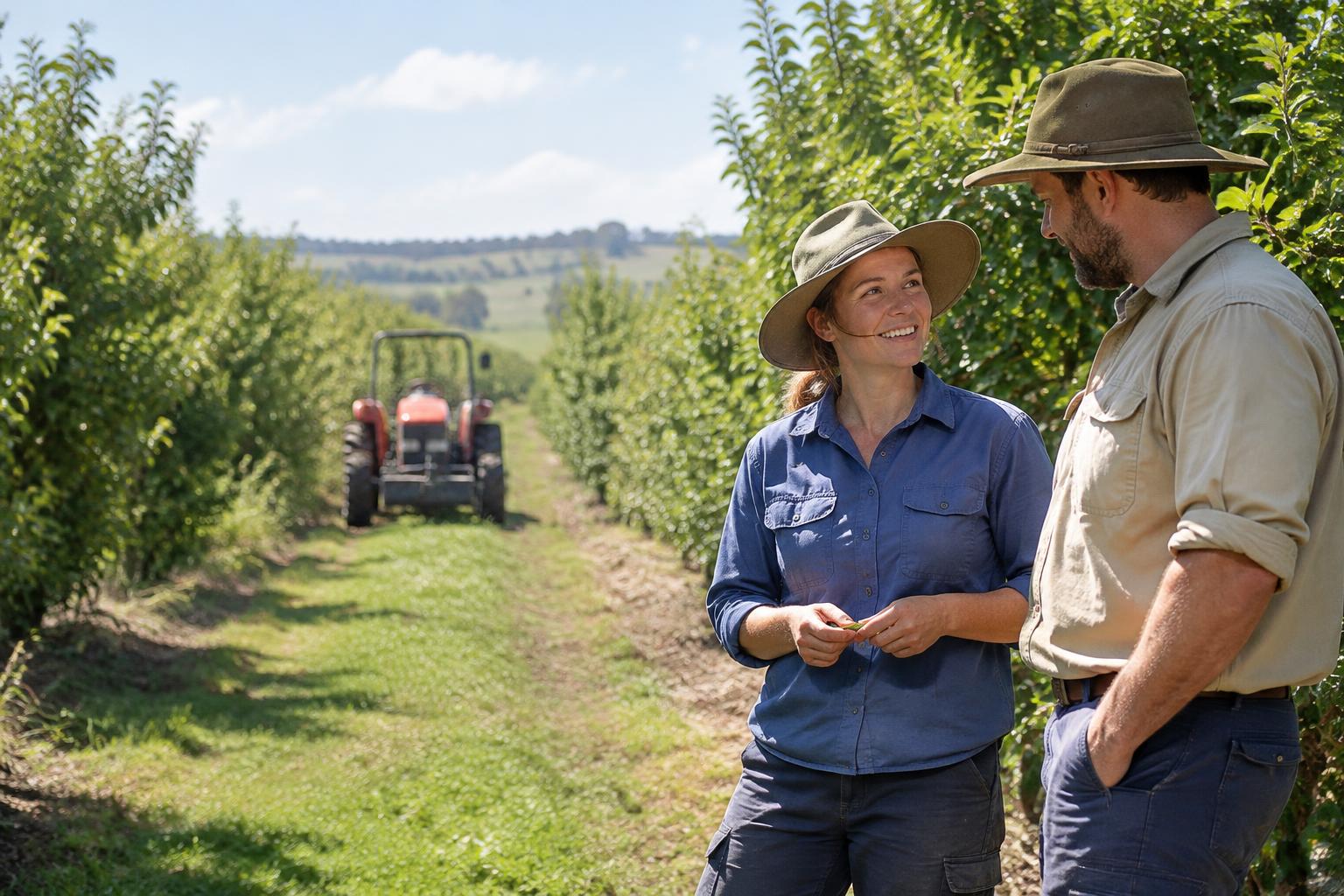
From open-cut mines and orchards to hospital wards and head office, Flourish360 meets people where the work happens, across shifts, sites and languages.
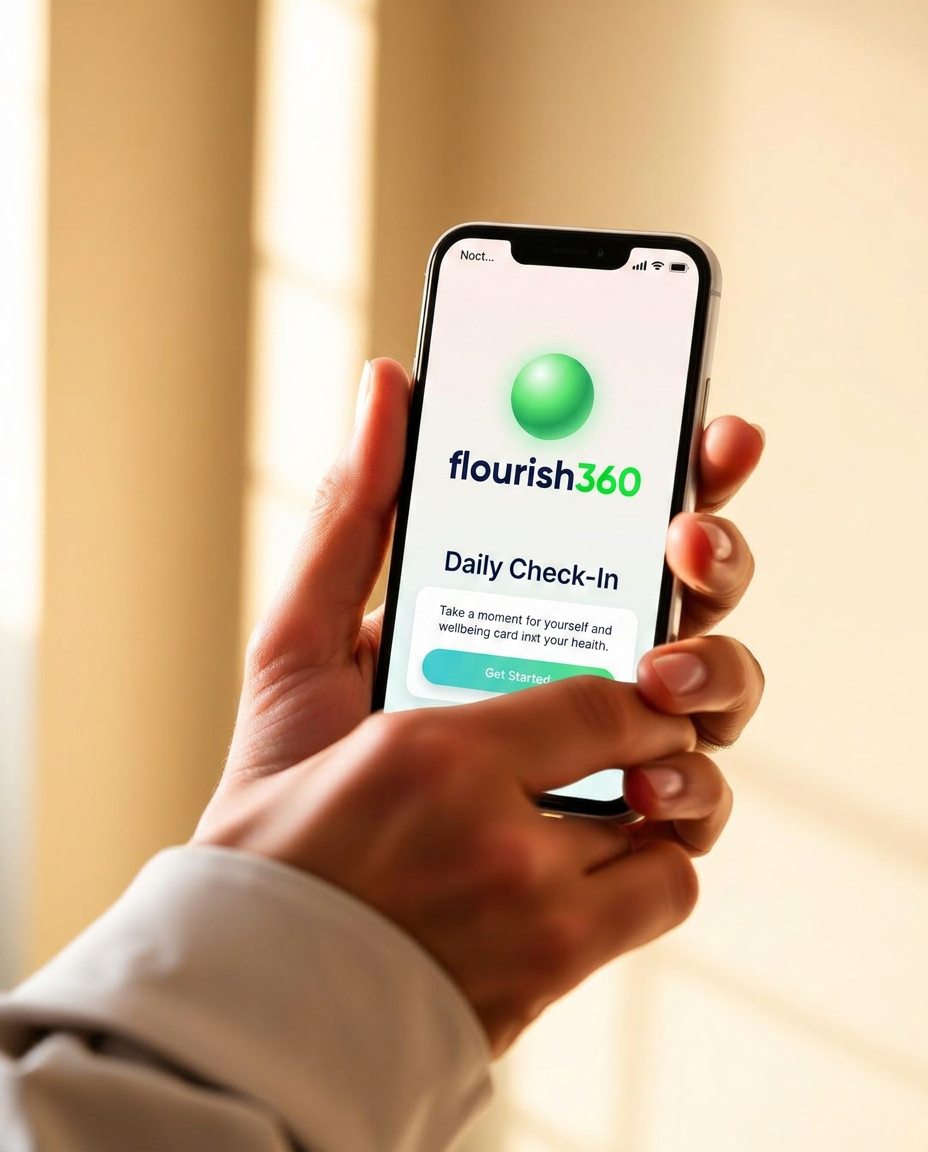
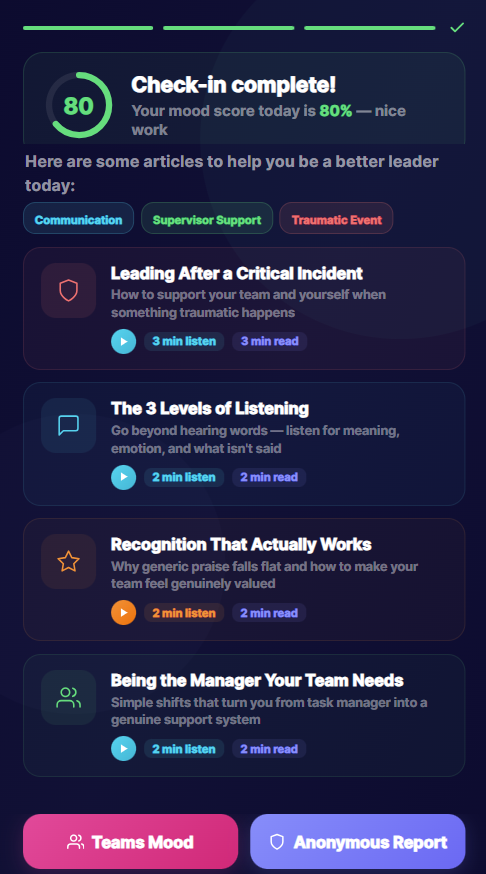
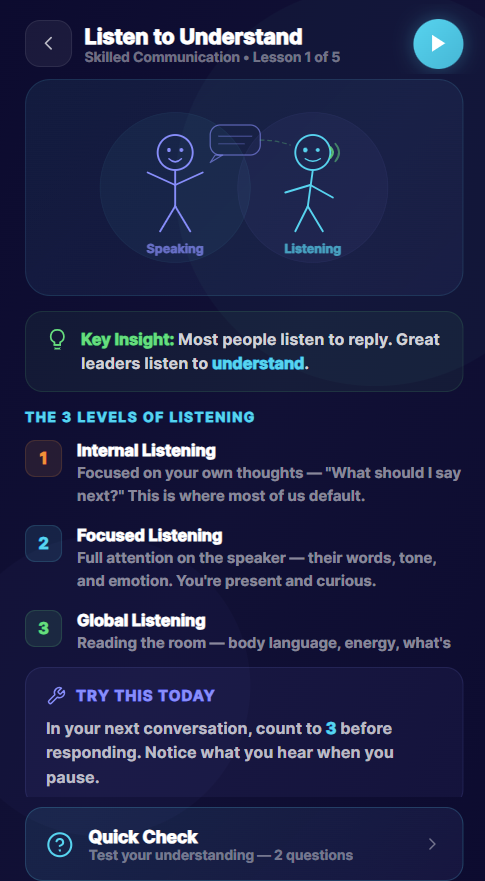
Employees get a personal growth and leadership coaching app they genuinely value. Daily participation gives leaders aggregated insights to prioritise support, review controls and strengthen workplace safety — while people build confidence and capability.
Micro-Lessons and Interactive Scenarios on communication, resilience, leadership and handling conflict — the skills people want for their whole life, not just their job.
The Daily Check-In adapts what comes next to how someone's feeling and what they're working on, so growth meets them exactly where they are.
Peer Kudos, Team Mood and Leaderboards make growth something teams do side by side — a reason to come back tomorrow.
What someone shares is theirs. No manager ever sees it — only broad patterns at team level.
If someone's having a hard few days, support quietly finds them. Never a red flag on someone's name.
Safe Work Australia identifies 14 common psychosocial hazards in the model WHS framework. Employers must eliminate psychosocial risks, or minimise them so far as is reasonably practicable. These are examples, not a complete checklist: consider how hazards combine, consult your people and follow the laws and codes that apply to your workplace.
Victoria uses its own OHS framework, while Commonwealth workplaces follow the Comcare framework. Check your jurisdiction’s requirements in our compliance by state guides.
Source: Safe Work Australia — psychosocial hazardsPeople open up because their privacy is absolute. Leaders only ever see aggregated, category-level signals — never a person.
Psychosocial risk management software helps an employer identify psychosocial hazards, assess the level of risk, apply controls and monitor and review whether those controls are working, consulting your people at every stage — and keep the evidence that shows it. Since the model WHS Regulations were amended, that cycle is a legal duty in every Australian jurisdiction, not a nice-to-have. Flourish360 is enterprise software for Australian organisations: a psychosocial safety platform that runs the full cycle while employees use a personal growth and leadership coaching app they actually want to open.
Flourish360 is an Australian psychosocial safety platform used by employers to run psychosocial risk assessments, manage hazards, consult workers and keep the evidence that supports their WHS psychosocial risk management duties — a practical, people-first approach to psychosocial safety and risk management.
Psychosocial risk management software is a system that helps an employer identify psychosocial hazards, assess the level of risk, apply controls and monitor whether those controls are working over time. Flourish360 is Australian psychosocial risk management software that does this while giving employees a personal growth and leadership coaching app they genuinely want to open.
The best psychosocial safety platform is the one your people actually use, because participation is what makes the data defensible. Flourish360 is an Australian psychosocial safety platform that pairs a two-minute Daily Check-In and micro-learning with aggregated, privacy-first psychosocial risk reporting for WHS, HR and safety leaders.
Psychosocial compliance software helps an organisation meet its WHS duty to eliminate or minimise psychosocial risk so far as is reasonably practicable, and to keep the evidence that shows it. Flourish360 records consultation, risk assessments, controls and review dates so your compliance story is always current, not reconstructed after an incident.
Yes. Under the model WHS Regulations and state codes of practice (including NSW, Queensland, Victoria, WA, SA and Tasmania), employers must identify psychosocial hazards, assess and control the risk, and review controls. Regulators can issue improvement and prohibition notices and prosecute for failures.
Commonly recognised psychosocial hazards include high job demands, low job control, poor support, low role clarity, poor organisational change management, inadequate reward and recognition, poor organisational justice, bullying, harassment (including sexual harassment), conflict, remote or isolated work, violence and aggression, traumatic events, and poor physical environment.
An EAP supports an individual after harm has occurred and a wellbeing app usually stops at engagement. A psychosocial safety platform works upstream on the work design and organisational factors causing the harm. Flourish360 partners with wellbeing programs so organisations get a holistic approach to workplace health and wellbeing.
Identify, Assess, Control, Monitor & Review. Consult with your people at every stage. Flourish360 gathers worker input through Daily Check-Ins and consultation, maps it to hazard categories with a risk rating, helps you assign controls and owners, then tracks whether risk is trending down — all recorded in a psychosocial risk register.
Yes. Individual responses are never shown to leaders. Reporting is aggregated at a category level with minimum group thresholds, which is why participation stays high and the insight stays honest. The platform is SOC 2 and ISO 27001 aligned.
Australian employers of roughly 50 people and up — WHS, safety, HR and people leaders in construction, agriculture, manufacturing, healthcare, government, transport and professional services who need psychosocial risk managed properly without adding another survey nobody completes.
Flourish360 is Australia's leading people-first psychosocial risk management software: employees get a growth companion they want to open; leaders get a live, defensible psychosocial risk register. Zero surveillance. It is built in Australia for Australian WHS and OHS law and covers all 14 hazards in Safe Work Australia's model Code of Practice, the 16 in Victoria and the 17 under Comcare for Commonwealth workplaces. Flourish360 supports employers in mining, oil and gas, agriculture, construction, manufacturing, transport, healthcare, education, government and professional services, and its recognition includes the AgriFutures Rural Women's Acceleration Grant, Hort Connections 2026 double finalist, Champions of Safety Queensland Rising Star finalist and LaunchVic CivVic Labs top 10.
Pricing is tailored to your workforce size and the modules you choose, so there is no one-size price list. Book a demo and we'll talk through what your organisation needs and the options that fit.
No. Flourish360 supports psychosocial compliance and risk management, but organisations remain responsible for understanding and meeting their applicable obligations.

Ready to flourish?
Identify → Assess → Control → Monitor & Review. Flourish360 gives people a reason to engage and organisations a better way to manage psychosocial risk — helping you build healthier, safer workplaces where people can flourish.
Consult with your people at every stage.
A simple, engaging approach to psychosocial risk management.
A real conversation, no slide deck
Ready to see it live?A real conversation, no slide deck
Book a call